


The Hidden Costs of Over-Drying Grain
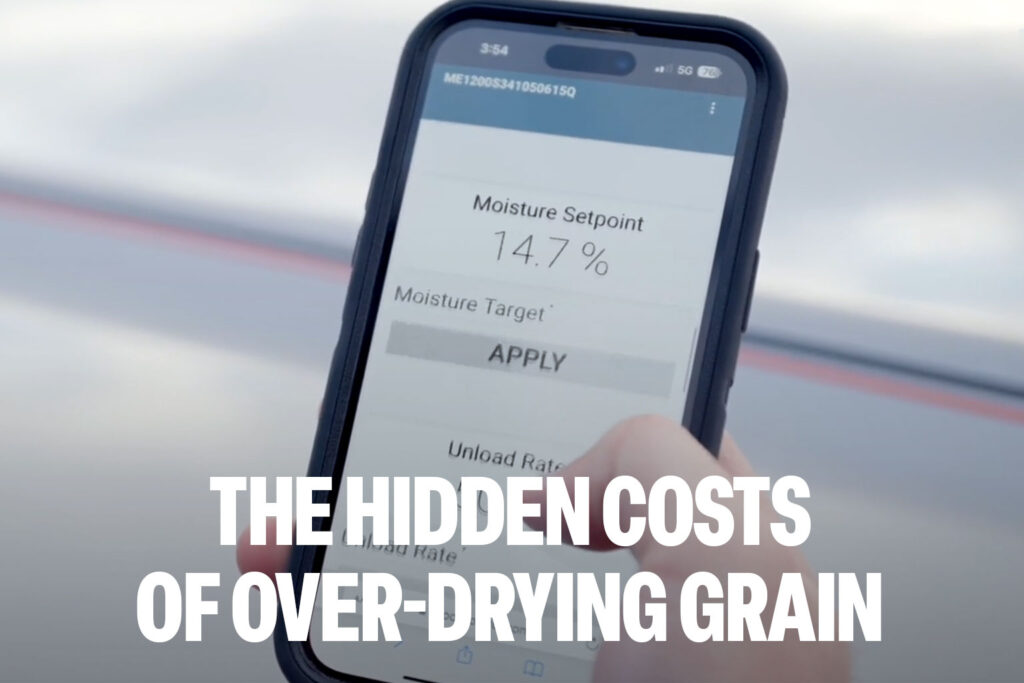
A few tenths of a percentage point separate the moisture reading on your dryer from the one on your bench tester. Do you adjust the calibration to bring them into agreement?
According to Brock District Manager Bill Winchell, that seemingly minor decision can significantly affect drying efficiency. Repeated calibration changes, particularly when readings are already within acceptable tolerances, can introduce inconsistencies that lead to unnecessary over-drying.
And removing those last points of moisture can cost considerably more than operators realize.
When Calibration Adjustments Work Against You
Winchell regularly encounters operators who compare their dryer’s moisture readings with a bench tester and adjust whenever the numbers differ.
The problem is that no two moisture measurement systems will produce identical readings every time. A difference of a few tenths may be within the acceptable tolerance of both devices.
Adjusting the dryer to match each new bench test can create a cycle of corrections that disrupts otherwise consistent operation.
“If you’re within that tolerance, don’t input a change,” Winchell advises.
His recommendation isn’t to stop testing. It’s to distinguish between monitoring performance and adjusting.
Instead of recalibrating after every sample, Winchell recommends recording readings and looking for a consistent pattern. If the difference remains within acceptable limits, the dryer may be operating exactly as intended.
The Cost of Removing Those Last Moisture Points
The relationship between moisture removal and drying efficiency isn’t linear. As grain becomes drier, removing additional moisture requires progressively more energy and time.
Winchell uses the example of squeezing water from a sponge. The first water comes out easily. Getting the last bit requires considerably more effort.
He recalls a study conducted by a dealer with an engineering background that compared dryer performance at different discharge moisture levels. In that example, drying corn from 15% down to 13% reduced throughput by approximately 30% while increasing drying costs by more than 30%.
The specific results will vary by dryer and operating conditions, but the principle is important: over-drying affects both fuel consumption and the number of bushels a dryer can process.
For an operation already working against harvest deadlines, lost throughput can be as consequential as additional fuel costs.
Consistency Matters More Than Matching Every Reading
Repeated calibration adjustments can also make automatic dryer controls less effective.
When moisture sensor inputs are continually changed, the dryer responds to those changes. Operators may see moisture readings fluctuate and conclude that automatic operation is unreliable, prompting further manual intervention.
Winchell has seen this cycle lead to increasingly inconsistent results.
“You’re spending a dime to save a nickel,” he says of over-drying grain to avoid a potential moisture discount.
The objective should be consistent moisture removal at the intended target, not forcing every individual measurement to agree.
Brock’s TrueGrain® Moisture Sensor System is designed to provide consistent moisture measurements, but like any moisture sensing technology, its effectiveness depends in part on proper operation and calibration practices.
A More Measured Approach to Moisture Management
Winchell encourages operators to continue checking samples, but to avoid making changes based on normal variations between readings.
“Just write down the numbers, don’t input any changes,” he advises when readings are within acceptable tolerances.
A consistent discrepancy that exceeds the equipment’s specified tolerance warrants investigation. A small difference that changes from sample to sample may not.
During harvest, those decisions add up. Maintaining stable dryer operation and avoiding unnecessary moisture removal can help protect throughput and control drying costs without compromising the intended moisture target.
For questions about calibration procedures or moisture sensor performance, consult your Brock dealer and the manufacturer’s operating guidelines.
To get the next article delivered to your inbox, subscribe to Brock News:
About Bill Winchell:
Bill Winchell is a District Manager at Brock Grain Systems with more than 35 years in the role and over 50 years of hands-on experience in the grain industry. He began his career in grain elevator operations in 1972, later managed a family farm machinery dealership, and then moved into grain systems sales with Butler Manufacturing before joining Brock when CTB acquired Butler Grain Systems in 1997. Today Bill covers Wisconsin, Minnesota, North Dakota, and western Canada, and is widely regarded within the company as a leading resource on grain dryer operations and service.

Bill Winchell
District Manager
Brock Grain Systems
When Your Grain Storage System Can’t Keep Up with Your Farm
Has your farm outgrown its grain system? Learn when to expand grain storage, drying, and handling capacity before harvest.
How to Make On-Farm Grain Storage Pay.
Part 5 of a 5-part series. Throughout this series, we’ve looked at tighter grain systems, harvest bottlenecks, and storage pressure. Now the question becomes: Does storage actually pay?
Is Your Grain System Ready if the Crop Holds?
Is your grain system ready for a strong crop? Evaluate storage capacity, handling speed, and harvest readiness before the combines start rolling.