





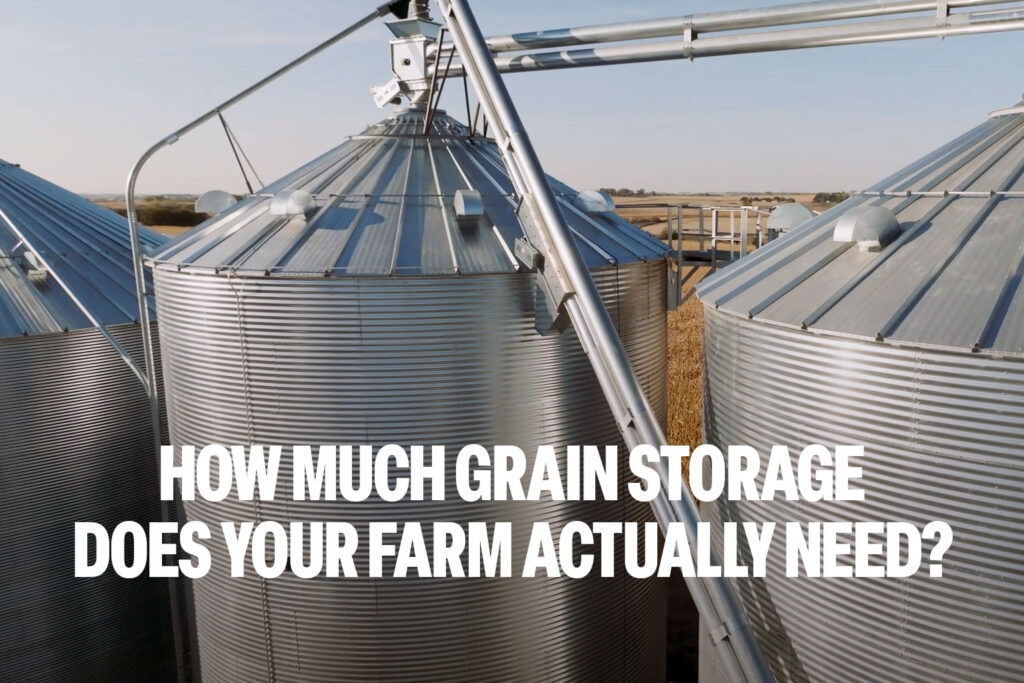
How Much Grain Storage Does Your Farm Actually Need?
Part 4 of a 5-part series
In the earlier articles in this series, part 2 and part 3, we looked at how the grain system is getting tighter—and how that pressure often shows up first during harvest.
As yields continue to grow, storage capacity matters more than it used to.
For a lot of farms, the question is no longer: “Do I need grain storage?”
It’s: “How much is enough?”
Start With Production vs. Capacity
The starting point is simple:
How many bushels are you harvesting—and how many can you actually hold?
Your storage needs are usually driven by:
- total production
- how fast harvest moves
- how quickly grain can leave the farm
A farm harvesting 250,000 bushels operates very differently depending on whether it can store 100,000 bushels or most of the crop.
The more dependent you are on immediate delivery during harvest, the more pressure you tend to feel when the system gets tight.
A Practical Way to Think About Capacity
Every operation is different, but one useful way to evaluate storage is by comparing on-farm capacity to annual production.
For example*:
- Around 50% storage capacity: A significant portion of the crop still needs to move off the farm during harvest, making you more dependent on elevator availability and delivery timing.
- Around 75% storage capacity: More of the crop can remain on-farm, creating additional flexibility during harvest and after the crop is in the bin.
- Around 100% storage capacity or more: Most or all of the crop can be stored on-farm, providing greater control over harvest flow, grain movement, and marketing decisions.
Recent data from Farmdoc** shows that on-farm storage utilization has already climbed to around 80% nationally in recent years.
At the same time, the overall grain system is getting tighter as well. In 2025, U.S. crop production reached roughly 95% of total grain storage capacity—the closest the two have been in decades.
That means a lot of farms are already running fairly tight on available space.
And when yields push higher than expected, that margin can disappear quickly.
Don’t Plan Around an Average Year
One of the biggest mistakes in storage planning is sizing a system around an average harvest.
Harvest rarely feels average.
The pressure usually shows up during:
- a big yield year
- a wet fall
- delayed delivery windows
- short harvest weather windows
A system that feels fine most years can suddenly feel undersized when conditions tighten up.
When that happens, the impact isn’t limited to harvest itself. Delays can push fall fieldwork later into the season, reducing the time available for tasks that help set up next year’s crop. Finishing harvest efficiently often creates more opportunities to complete fall work and be better positioned for spring planting.
That’s why many farms are starting to think less about average production—and more about handling peak pressure.
A Simple Way to Gut Check Your System
One easy way to evaluate your system is to compare projected production against current storage.
A simple calculator could include:
- total acres
- expected yields
- crop mix
- current storage capacity
From there, you can estimate:
- total bushels produced
- how much of the crop you can store
- where possible gaps may exist
For farmers planning future storage needs, John Strickland, a corn, cotton and peanut farmer from Blackshear, Georgia, recommends building with growth in mind.
“Get it 20–30% bigger than you think you need — but more importantly, build your system so you can grow into it,” Strickland said. “Cash flow won’t let you build double what you need, but at least give yourself a little cushion, and make sure you can add on later at no extra cost beyond the expansion itself.”
It’s not about building a perfect forecast. It’s about getting a better feel for where pressure could show up before harvest starts.
Storage Impacts More Than Harvest
Storage doesn’t just affect harvest. It affects:
- when you sell grain
- how you market grain
- whether you have the ability to wait
According to Strickland, storage also changes who controls the timing of grain sales and marketing decisions.
“When you have control of it, in your possession, people have to come to your terms,” he said.
The more flexibility you have after harvest, the more control you usually have over your marketing decisions throughout the year. Without storage, those decisions are often driven by timing instead of strategy.
Storage can also affect what happens after harvest is complete. Farms that can keep grain moving efficiently often have more time available for fall fieldwork, helping position the operation for a smoother start when spring planting arrives.
Terry Hall, a corn, soybean and rice farmer from Lake City, Arkansas, said on-farm storage has helped his operation make better use of labor during both harvest and post-harvest fieldwork.
“We can harvest our crop with a skeleton crew and get fieldwork done because of the grain bins,” Hall said. “We’re running three or four trucks where we’d otherwise need ten or twelve — we can put those extra guys to work in the fall doing fall prep instead.”
Hall said the impact of storage becomes especially noticeable when considering harvest efficiency.
“We’re 50% faster with the storage,” he said. “We’ve got a neighbor about our size who doesn’t have near the grain storage we do, and we finish well ahead of him — they sit in the field a lot waiting on trucks.”
The Moments Most Farms Recognize
If your bins are full before harvest is finished, you’ve probably felt this.
If you’ve ever found yourself deciding where grain can go instead of when you want to move it, you’ve probably felt it too. As the system gets tighter, those moments tend to happen more often.
The Bottom Line
This isn’t really about having the biggest system possible.
It’s about having enough storage to keep harvest moving, create flexibility after the crop is in the bin, and help the entire operation stay on schedule during a busy season.
Because in a tighter grain system, flexibility matters more than it used to.
Brock Perspective
The right amount of storage isn’t a fixed number. It’s the amount that helps you keep harvest moving efficiently and gives you more flexibility after harvest.
* These examples are intended to illustrate how storage capacity can influence operational flexibility. The right amount of storage varies by operation, crop mix, harvest speed, local delivery options, and marketing strategy.
** Janzen, J. US Grain Storage Capacity Growth Has Stopped. farmdoc daily (16): 20, Department of Agricultural and Consumer Economics, University of Illinois at Urbana-Champaign, February 9, 2026.
To get the next article in this series delivered to your inbox, subscribe to Brock News:
About the author:
William Davenport is a District Manager at Brock Grain Systems, serving customers across the southeastern United States. He joined Brock in 2025, bringing more than 20 years of experience in agricultural sales, marketing, and product management. Prior to joining Brock, he worked for a large farm equipment dealership based in Kentucky, where he managed new equipment inventory planning, evaluated equipment orders and transfers, and collaborated with more than 30 equipment manufacturers and suppliers. With a background spanning equipment sales, inventory management, and agricultural operations, Davenport brings a practical perspective to helping farmers make informed decisions about grain storage and handling systems.

District Manager
Brock Grain Systems
More from this series
Is Your Grain System Ready for the Next Record Harvest?
Part 2 of a 5-part series. In a recent article, we looked at how the grain system is tightening. One of the first places that shows up is during harvest.
The Hidden Cost of Harvest Bottlenecks.
Part 3 of a 5-part series. Previously we looked at how tighter storage shows up during harvest. One of the biggest impacts isn’t just operational—it’s financial.